
How to Verify Unclear Ingredients on Japanese Food Labels Before Buying
Finding suitable halal food in Japan is not always as simple as checking a product’s name or recognizing its ingredients. A packaged snack, sauce, dessert, or ready-made meal may contain additives whose origins are not immediately clear from the label.
For Muslim shoppers, the important question is often not just what is this ingredient? but where did it come from, and how was it produced?
When a Japanese food label contains an ingredient of uncertain origin, the safest practical approach is to check the manufacturer’s information, ask specific questions, and avoid assuming the product is halal until the uncertainty has been resolved.
This guide explains how to verify unclear ingredient information, contact food manufacturers in Japan, and make more informed purchasing decisions.
Why Some Japanese Food Ingredients Need Further Verification
Japanese packaged foods usually include an ingredient declaration, but a legally compliant ingredient list does not necessarily provide every detail needed for a halal assessment.
Some ingredient names identify their function rather than their original source. For example, a food additive may be derived from plant or animal materials, depending on how the manufacturer produces it.
Similarly, a label may identify a flavoring without listing every detail about its formulation.
That does not automatically mean a product is non-halal. It means the available information may be insufficient to determine its suitability.
What Should You Do When an Ingredient Is Unclear?
Follow this simple process:
- Identify the exact ingredient that needs clarification.
- Check the complete ingredient list and product information.
- Look for relevant halal certification details.
- Contact the manufacturer or seller when the source remains uncertain.
- Assess the response against your halal requirements.
- Leave the product unverified if essential information cannot be confirmed.
This approach is more useful than treating every unfamiliar ingredient as automatically prohibited.
1. Identify the Ingredient That Needs Clarification
Before contacting a manufacturer, first identify exactly what information is missing.
For example, suppose a packaged dessert contains gelatin. The label may tell you that gelatin is present, but it may not identify the animal source or certification status.
In another product, a flavoring or emulsifier may be listed without enough detail to establish whether it is plant-derived, animal-derived, or otherwise suitable.
Ingredients Worth Investigating
| Ingredient or description | What may need verification |
|---|---|
| Gelatin | Animal source and relevant halal certification |
| Emulsifiers | Source materials and manufacturing details |
| Flavorings | Ingredients or carriers of halal concern |
| Shortening | Plant or animal fat source |
| Enzymes | Biological source and processing information |
| Meat extract or broth | Animal species and halal slaughter status |
| Alcohol-containing seasonings | Type, purpose, and formulation |
These ingredients are not all automatically non-halal. Their suitability depends on their actual origin, processing, certification, and the halal standards you follow.
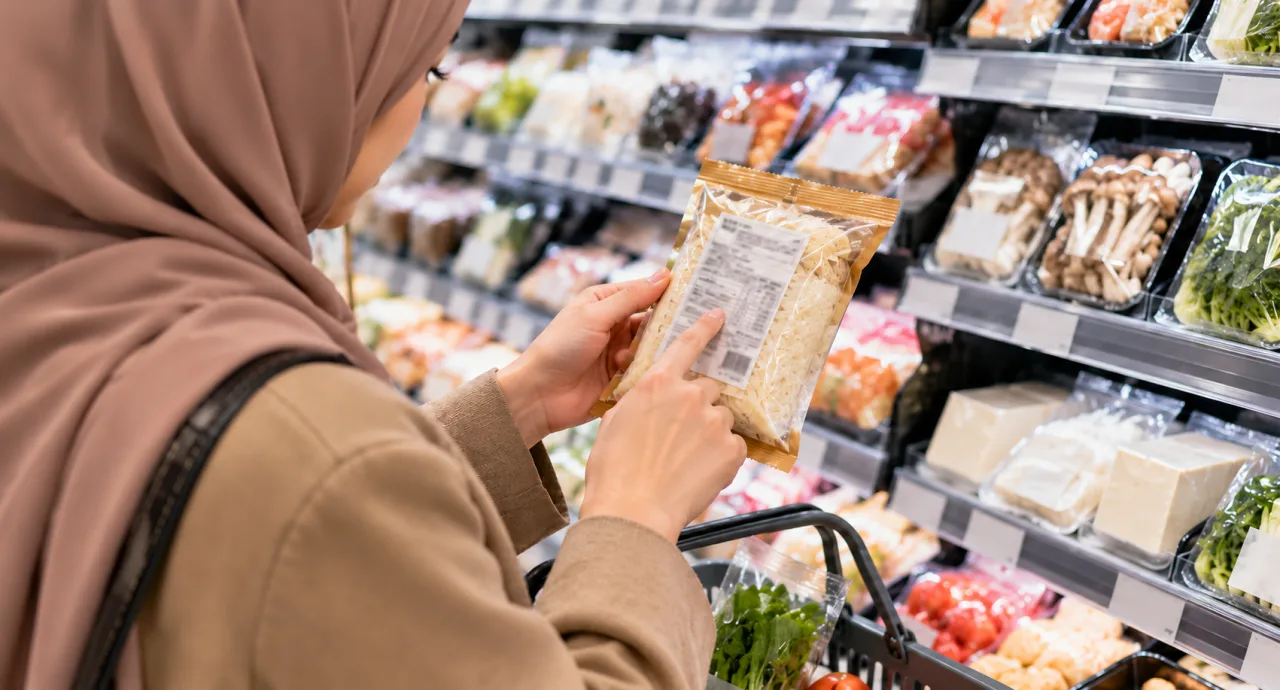
2. Check the Complete Product Label
When reviewing a packaged product, do not rely on the front label alone.
Turn the packaging over and locate the ingredient information.
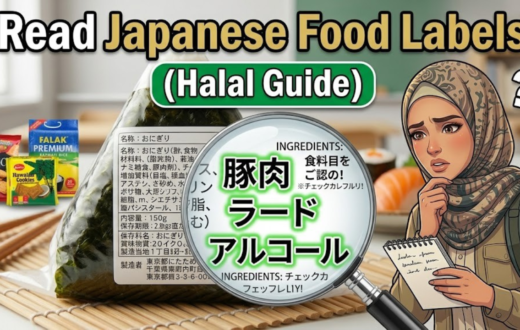
In Japanese, the ingredient declaration is usually identified by 原材料名 (genzairyōmei).
Other useful information may include:
| Japanese label | English meaning |
|---|---|
| 原材料名 | Ingredients |
| 添加物 | Additives |
| 内容量 | Net quantity |
| 賞味期限 | Best-before date |
| 消費期限 | Use-by date |
| 保存方法 | Storage instructions |
| 製造者 | Manufacturer |
| 販売者 | Seller or distributor |
The manufacturer or distributor information is especially useful when you need clarification about an ingredient.
A product name or marketing statement alone should not replace a review of its full ingredient information.
For an introductory explanation of common Japanese ingredient terms, see MT Halal’s existing article, A Beginner’s Guide to Reading Japanese Food Labels for Muslims.
3. Look for Relevant Halal Certification Information
A halal certification mark can provide useful information, but it should be checked rather than accepted without context.
Different certification bodies may follow different requirements, and certification may apply to particular products or production facilities rather than everything a company sells.
Questions to Consider
- Which organization issued the certification?
- Does the certification apply to the exact product?
- Is it relevant to the product’s current formulation?
- Can the certificate or product listing be verified?
- Does the certification meet your personal halal requirements?
Where possible, check the certification body’s official information or ask the manufacturer for confirmation.
Important: The absence of a certification logo does not automatically make a product haram, just as the presence of an unfamiliar logo should not be treated as sufficient verification by itself.
For a broader explanation, read MT Halal’s existing guide, Understanding Halal Certification in Japan – What Every Buyer Should Know.
4. Contact the Manufacturer When Information Is Incomplete
If the packaging does not provide enough information, contacting the manufacturer is often the most direct next step.
Look for the manufacturer’s customer service website, email address, or contact details printed on the packaging.
When sending an enquiry, include enough details to identify the product correctly.
Information to Include
- Product name
- Brand or manufacturer
- Package size
- Product code, if available
- A photograph of the ingredient label
- The specific ingredient requiring clarification
- The exact question you want answered
Avoid sending a general message such as “Is this food halal?” without identifying your concern.
The manufacturer may not be able to issue a religious ruling, but it may be able to provide factual information about ingredient sources and manufacturing processes.
Example: Asking About Gelatin
Instead of asking only whether the product is halal, ask:
“Could you confirm whether the gelatin used in this product comes from fish, cattle, pigs, or another source? If animal-derived, is any halal certification information available?”
This helps the manufacturer understand what information you need.
Example: Asking About an Emulsifier
You can ask:
“Could you please confirm whether the emulsifier in this product is derived from plant-based or animal-based materials?”
If the response identifies an animal source, further questions about certification or processing may still be necessary.
5. Useful Japanese Messages for Manufacturer Enquiries
You do not need fluent Japanese to begin asking questions about a food product.
A short and respectful message can help customer service understand your request.
General Ingredient-Source Enquiry
Japanese:
こちらの商品の原材料について確認したいことがあります。原材料の由来を教えていただけますか。
English meaning:
I would like to confirm something about the ingredients in this product. Could you please tell me their origins?
Gelatin-Source Enquiry
Japanese:
この商品に使用されているゼラチンの由来を教えていただけますか。豚、牛、魚、またはその他の原料でしょうか。
English meaning:
Could you tell me the source of the gelatin used in this product? Is it derived from pork, cattle, fish, or another material?
Emulsifier-Source Enquiry
Japanese:
この商品に使用されている乳化剤は、植物由来ですか、それとも動物由来ですか。
English meaning:
Is the emulsifier used in this product derived from plants or animals?
Asking About Halal Certification
Japanese:
この商品はハラール認証を取得していますか。取得している場合は、認証機関を教えていただけますか。
English meaning:
Does this product have halal certification? If so, could you tell me which organization issued it?
These are sample enquiries, not official certification requests. Include the product name and other identifying information when contacting a company.
6. Understand What the Manufacturer’s Answer Actually Confirms
A response from a manufacturer can be useful, but it is important to understand its limits.
For example:
| Manufacturer response | What it tells you |
|---|---|
| “The emulsifier is plant-derived.” | Confirms the stated source, but not necessarily the entire product’s halal status |
| “The gelatin is pork-derived.” | Identifies a source generally unsuitable for halal diets |
| “The gelatin is bovine-derived.” | Identifies the animal; slaughter and certification questions may remain |
| “The product contains no pork ingredients.” | Does not rule out all other halal concerns |
| “We cannot disclose the source.” | Important information remains unverified |
| “The product is halal-certified.” | Ask which certificate applies to the exact product |
The goal is to collect enough reliable information to make a decision consistent with your halal requirements.
If the answer does not resolve the concern, request clarification or choose another product.
7. Do Not Confuse Allergen Labels with Halal Certification
Japanese food packaging also provides allergen information, which serves a different purpose from halal verification.
Allergen labels help consumers identify ingredients associated with food allergies.
They do not independently verify the religious suitability of a product.
For example, a packaged food may declare milk, egg, wheat, or another allergen while still containing flavorings or processing ingredients that need separate halal assessment.
Likewise, a product may be suitable for people with particular dietary restrictions without necessarily meeting halal requirements.
For official consumer information about Japanese food labeling, refer to the Consumer Affairs Agency’s Food Labelling resources.
8. How to Check Packaged Foods When Shopping Online
Online shopping adds another practical challenge: you cannot always inspect the physical packaging before placing an order.
When browsing packaged groceries online in Japan, check the available product details carefully.
Review the Product Listing
Look for:
- Full product name and brand
- Package size
- Available ingredient information
- Certification information, where provided
- Product photographs showing the label
- Manufacturer details
- Relevant customer support information
If the product listing does not provide the details you need, ask the seller before purchasing.
Request Clarification When Necessary
A useful message to an online grocery store might be:
“Could you please provide the ingredient information or confirm the source of the gelatin/emulsifier in this product?”
This is particularly helpful when buying imported sauces, packaged desserts, processed snacks, or ready-made foods with multiple ingredients.
MT Halal Mart offers Pakistani and Indian halal grocery products through its online store, with home delivery across Japan and a physical grocery store in Yotsukaido, Chiba.
You can explore the available products through the MT Halal Mart Shop.
For any product with unclear ingredient or certification information, request clarification rather than assuming that every item has identical certification.
9. Keep a Personal Record of Verified Products
Once you have confirmed important product details, keeping a simple record can make future shopping easier.
You can use a notebook, spreadsheet, or phone note.
Example Verification Record
| Product | Ingredient checked | Information received | Next action |
|---|---|---|---|
| Packaged dessert | Gelatin | Source not confirmed | Ask manufacturer |
| Biscuit | Emulsifier | Plant-derived, manufacturer confirmed | Review remaining ingredients |
| Ready-made sauce | Flavoring | Further information requested | Await clarification |
| Certified packaged food | Certification | Certificate checked for the product | Review current packaging |
These are illustrative examples, not findings about specific products.
Record the date of confirmation because recipes, suppliers, and packaging can change.
Why a Verification Record Helps
A personal record can help you:
- Avoid repeating the same enquiries
- Remember which ingredients were previously checked
- Compare product formulations
- Identify items that require follow-up
- Notice changes in packaging or ingredient lists
However, previous confirmation should not automatically be applied to a product after a formulation change.
10. What If You Still Cannot Verify a Product?
Sometimes a manufacturer cannot disclose ingredient sources or provide the certification information you need.
In that situation, you have several practical options.
You can look for a comparable product with clearer ingredient information, consult a qualified halal certification organization, or ask a knowledgeable religious authority about an unresolved ingredient question.
Avoid treating guesses, social media comments, or machine translations as conclusive evidence.
A translation tool can help identify the wording on a package, but it cannot establish how an ingredient was manufactured.
Quick Checklist Before Buying Packaged Food in Japan
Use these questions when a packaged product contains ingredients that are unclear:
- Have I checked the complete ingredient list?
- Do I understand the ingredient that needs verification?
- Have I reviewed available halal certification information?
- Can I identify the manufacturer or distributor?
- Have I asked a specific question about the unclear ingredient?
- Does the response confirm the source and relevant processing details?
- Is the information applicable to this exact product?
- Have I checked whether the product formulation has changed?
- If uncertainty remains, is there a clearer alternative?
Frequently Asked Questions
Does a Japanese ingredient label confirm whether a product is halal?
Not necessarily. An ingredient label identifies ingredients and other required product information, but it may not specify every source or processing detail needed for a halal assessment.
Is a plant-derived emulsifier always enough to confirm a product is halal?
No. Confirming that one emulsifier is plant-derived answers one ingredient-source question. Other ingredients and manufacturing considerations may still need verification.
Can Japanese food manufacturers confirm halal certification?
Some manufacturers may be able to identify applicable certification or provide ingredient-source information. Their responses vary, and not every manufacturer offers certified halal products.
Are translation apps enough to check halal ingredients?
Translation apps can help you understand Japanese ingredient names, but they cannot independently verify halal certification, animal slaughter methods, or processing details.
What should I do if a manufacturer does not answer my question?
If essential information remains unavailable, consider another product with clearer documentation or seek guidance from an appropriate halal certification organization.
Final Thoughts
Checking halal food in Japan requires more than recognizing familiar words on a package.
When ingredients are unclear, focus on identifying the specific concern, gathering factual information from the manufacturer, verifying relevant certification, and making a decision based on reliable evidence.
With these steps, you can approach Japanese packaged-food shopping more confidently without assuming every unfamiliar ingredient is prohibited or every familiar-looking product is suitable.
For Pakistani and Indian grocery products, browse the MT Halal Mart online shop or visit its physical grocery store in Chiba. Always check the details of the exact product you intend to purchase.

1 Comment