How to Portion Halal Meat Before Freezing for Small Households
Buying a large pack of halal chicken, beef, or mutton can be convenient, but storing the entire pack as one frozen block can make everyday cooking difficult. If you only need enough meat for one or two people, thawing a large quantity creates unnecessary work and can leave you wondering what to do with the rest.
For students, couples, and small families living in Japan, dividing meat into meal-sized freezer portions offers a practical solution.
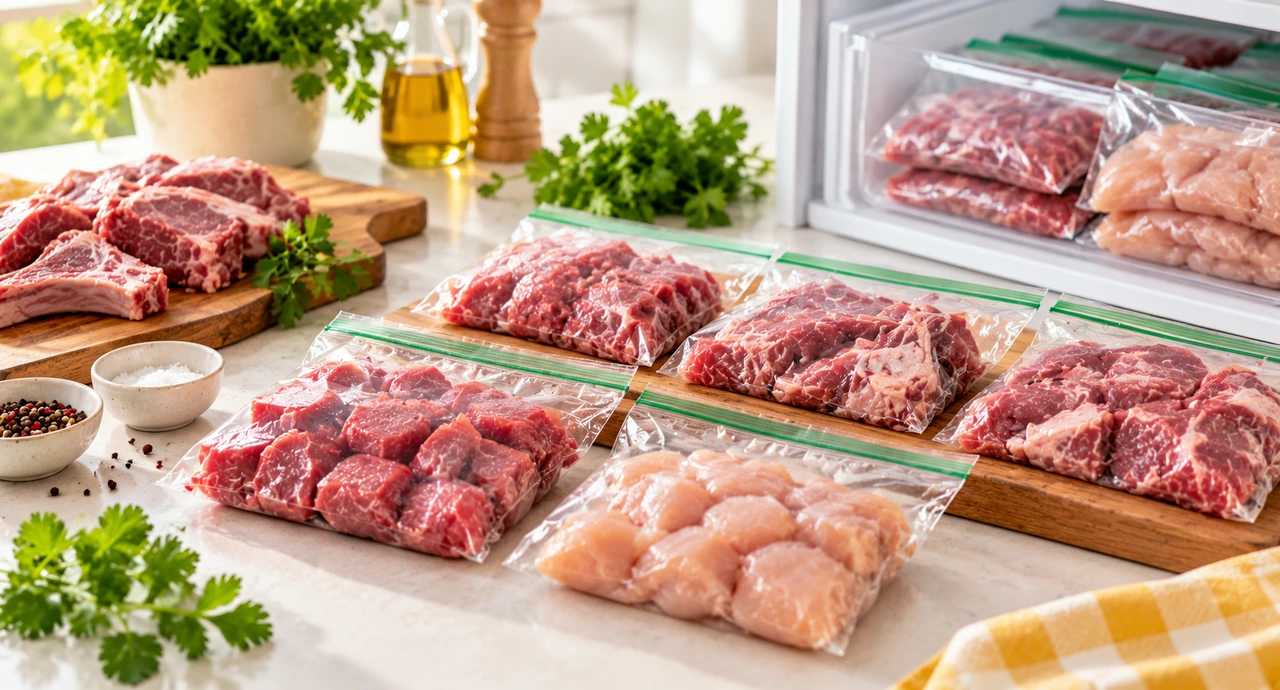
The simplest approach is to decide how much meat one meal requires, divide the pack while it is safely chilled, wrap each portion separately, and label it before freezing.
This guide explains how to choose portion sizes, pack different types of halal meat, and organize a small freezer without overbuying.
How Much Halal Meat Should You Freeze per Portion?
For an everyday meal where meat is the main ingredient, approximately 125–200g of raw boneless meat per adult can be a useful starting estimate.
This is a shopping and meal-planning estimate, not a fixed dietary requirement. Actual needs depend on appetite, recipe, age, other ingredients, and how many dishes are served.
Bone-in cuts generally require a higher purchase weight because the bones are included.
| Household size | Raw boneless meat per meal | Raw bone-in meat per meal |
|---|---|---|
| 1 person | 125–200g | 200–300g |
| 2 people | 250–400g | 400–600g |
| 3 people | 375–600g | 600–900g |
These are approximate starting points. A chicken curry containing potatoes or vegetables may need less meat than a meat-focused barbecue.
For mixed cuts with a high proportion of bone, additional weight may be necessary.
1. Start with the Meals You Actually Cook
Before dividing a meat pack, think about the recipes your household regularly prepares.
For example, someone living alone may prefer smaller portions for chicken curry, qeema, or a rice bowl.
A couple may need larger quantities for a shared evening meal, especially if they intend to prepare leftovers for the next day.
Match the Portion to the Recipe
| Meal | Example raw meat portion for two | Type of meat |
|---|---|---|
| Chicken and vegetable curry | 300g | Boneless chicken |
| Qeema matar | 300–350g | Beef mince |
| Beef and potato curry | 350–400g | Boneless beef |
| Mutton curry | 450–550g | Bone-in mutton |
| Chicken wraps | 250–300g | Boneless chicken |
All quantities are illustrative. Adjust them to your preferred serving size and other ingredients.
The main idea is to freeze the amount you usually need for one cooking session, rather than dividing everything into identical portions.
2. Calculate Portions Before Opening a Large Pack
A little arithmetic can make portioning easier.
Use this formula:
Number of portions = Total raw meat weight ÷ Planned weight per portion
For example, suppose you have a 1kg pack of boneless chicken and usually cook 250g at a time.
1,000g ÷ 250g = 4 portions
You can divide the pack into four 250g portions, assuming it is safe to handle and portion the product in its current condition.
Example: One Kilogram of Beef Mince
A 1kg pack could be divided as follows:
| Portion | Weight | Possible use |
|---|---|---|
| Pack 1 | 250g | Qeema with vegetables |
| Pack 2 | 250g | Qeema paratha filling |
| Pack 3 | 250g | Qeema matar |
| Pack 4 | 250g | Spiced minced beef with rice |
This provides four separate cooking portions rather than one large frozen block.
For a two-person household with larger servings, an alternative might be two 400g packs and one 200g pack.
There is no single correct distribution. Choose amounts based on your cooking habits.
3. Portion Boneless Chicken for Different Meals
Boneless chicken is relatively easy to divide because you do not need to account for bones.
If you frequently make chicken karahi, grilled chicken, or quick curry, separate portions according to the amount each recipe normally uses.
For example, an appropriate chilled 1kg pack could be divided into:
- Two 300g portions for shared meals
- Two 200g portions for smaller meals
This makes it easier to retrieve only what you need.
Should You Cut Chicken Before Freezing?
You can cut chilled boneless chicken into recipe-sized pieces before freezing if you have enough time to work safely.
Use clean utensils, keep the chicken cold, and package it promptly.
For example:
- Cubes for curry
- Strips for stir-frying
- Larger pieces for grilling
If the chicken is already individually packed or vacuum-sealed, it may be more practical to leave those portions sealed.
Check whether the product arrives chilled or already frozen. Do not thaw a large frozen block on the counter just to separate it.
To understand the different chicken cuts available for home cooking, browse the MT Halal Meat & Poultry collection.
4. How to Portion Beef Mince Without Creating Large Frozen Blocks
Beef mince is particularly suitable for flat freezer portions.
Instead of storing a thick ball of mince, press each measured portion into a thin, even layer inside a freezer-safe bag.
Keep the bag securely sealed and remove excess air without squeezing out meat juices.
Why Flat Portions Are Useful
Flat packs:
- Fit into narrow freezer compartments
- Stack more neatly once frozen
- Are easier to identify
- Generally thaw more evenly than thick blocks
- Help you remove one planned meal portion
A flattened pack is especially convenient for people using compact Japanese apartment refrigerators.
Example: Preparing 500g of Mince
If you usually cook for one person, you might create:
- Two 200g freezer portions
- One 100g portion for a smaller filling or dish
If you’re preparing qeema for two people, two 250g portions may be more suitable.
The important point is to avoid defrosting the entire pack just to take out a small amount.
5. Portion Bone-In Mutton and Chicken by Meal Weight
Bone-in cuts need a different approach because not all of the package weight is edible meat.
A 500g portion of bone-in mutton is not equivalent to 500g of boneless mutton.
The proportion of bone varies by cut.
Tips for Bone-In Portions
When dividing bone-in meat:
- Weigh the portion as purchased.
- Include a reasonable mix of meaty and bony pieces.
- Keep similarly sized pieces together where possible.
- Use durable, freezer-safe packaging.
- Check that sharp bone edges do not puncture the bag.
For mutton curry, you may prefer larger bone-in portions than you would for boneless beef or chicken.
For broth-based cooking, you can also organize portions by intended recipe, such as mutton yakhni or chicken pulao.
If you’re choosing between cuts, bone-in and boneless products have different advantages. Review the available meat selections through the MT Halal online shop.
6. How to Pack Halal Meat Properly for the Freezer
Once you’ve decided the portion sizes, packaging helps protect the meat from drying out and developing freezer burn.
Use materials specifically intended for freezing, such as freezer-grade bags, suitable containers, or freezer paper.
Step-by-Step Freezer Packing
Step 1: Prepare your workspace
Clean your work surface and have your bags, labels, and containers ready before handling raw meat.
Step 2: Keep the meat cold
Work with chilled meat and keep preparation time short. If it is already frozen, follow safe thawing guidance and the product’s handling instructions before repackaging.
Step 3: Weigh each portion
Use a kitchen scale to measure a quantity suited to one meal.
Step 4: Pack each portion separately
Place the meat in a suitable bag or container. Avoid overfilling it.
Step 5: Reduce excess air
Remove unnecessary air before sealing to limit contact with the meat’s surface.
Step 6: Label the package
Write the meat type, weight, and freezing date.
Step 7: Freeze promptly
Arrange new packages in a single layer with space for cold air to circulate. Once frozen solid, they can be stacked more compactly.
What About Original Packaging?
Unopened vacuum-sealed meat can usually remain in its intact packaging for freezing, provided the product instructions allow it.
Ordinary supermarket wrapping may need an additional freezer-safe outer layer for longer storage.
If a product arrives already frozen in individual portions, keep it frozen rather than opening and repacking it unnecessarily.
7. Create a Simple Freezer Labeling System
Labels help prevent forgotten packages and make dinner preparation easier.
At a minimum, write three details:
Meat type — Weight — Freezing date
For example:
<box> Chicken Breast — 300g — 13 Oct 2026
Beef Mince — 250g — 13 Oct 2026
Bone-In Mutton — 500g — 13 Oct 2026
</box>
You can also add the intended recipe if that is helpful.
For example:
Beef Mince — 300g — Qeema Matar — 13 Oct 2026
Use waterproof freezer labels or a marker suitable for plastic food-storage bags.
Why Add the Freezing Date?
The freezing date helps you rotate older packages before newer ones.
This is useful because meat can remain microbiologically safe for an extended period when constantly frozen at the proper temperature, but its quality may gradually decline.
A simple first-in, first-out system can help reduce food waste.
8. Organize a Small Japanese Apartment Freezer
Not everyone living in Japan has a large standalone freezer.
Students, couples, and residents of compact apartments may have limited freezer drawers or small refrigerator-freezer combinations.
That’s why package shape matters almost as much as portion weight.
Make Better Use of Limited Space
Use these ideas:
- Freeze boneless meat in thin, flat packages where practical.
- Group chicken, beef, and mutton separately.
- Keep labels facing outward.
- Avoid oversized storage containers.
- Leave room for air circulation and other frozen groceries.
- Keep a simple record of what is already frozen.
Once the packages are frozen solid, flat bags can often be stored vertically like files, depending on freezer design.
Avoid overcrowding the freezer, particularly when adding newly packaged unfrozen meat.
Check Your Freezer Temperature
For frozen meat, aim to maintain −18°C (0°F) or colder.
Some small refrigerator compartments cannot consistently maintain this temperature. Follow the appliance’s temperature ratings and the product’s storage instructions.
A freezer thermometer can help you check the actual temperature.
9. How Long Can You Keep Portion-Packed Meat Frozen?
Freezing helps preserve meat, but quality does not remain unchanged forever.
The following are general freezer-quality guidelines for meat stored continuously at approximately −18°C or colder.
| Meat type | Approximate quality guidance |
|---|---|
| Raw ground beef or mutton mince | 3–4 months |
| Raw beef or mutton steaks, chops, or roasts | 4–12 months |
| Raw chicken pieces | Up to 9 months |
| Raw whole chicken | Up to 12 months |
| Cooked meat dishes and stews | Often 2–3 months, depending on dish |
These periods concern quality rather than a fixed safety expiry. Actual storage life depends on the product, packaging, freezer temperature, and handling history. Follow a shorter manufacturer’s storage limit when one is provided.
Freezer burn can affect flavor and texture even when meat has remained frozen.
Good packaging and sensible rotation are therefore important.
10. A One-Week Meat Portion Plan for a Two-Person Household
Here is an example of how a couple could prepare a modest selection of meat portions.
| Planned meal | Raw meat | Portion |
|---|---|---|
| Chicken curry | Boneless chicken | 350g |
| Qeema matar | Beef mince | 350g |
| Mutton salan | Bone-in mutton | 500g |
| Chicken stir-fry | Boneless chicken | 300g |
Example total: 1.5kg of raw meat, divided across four cooking sessions.
This is a planning example, not a recommended weekly meat intake. A balanced meal plan can include lentils, vegetables, eggs, fish, and other foods as preferred.
A household may use these portions across more than one week rather than cooking all four meals immediately.
The purpose is to make each frozen pack match a planned dish.
11. Buying Meat in Suitable Quantities from MT Halal Mart
When planning halal meat delivery in Japan, check the available package weights before placing an order.
MT Halal Mart has offered different chicken, beef, and mutton products through its Meat & Poultry selection, including boneless cuts, minced meat, and bone-in options.
For smaller households, the best purchasing decision depends on:
- How many meals you want to prepare
- The size of each product pack
- Whether the meat is chilled or frozen
- Your freezer capacity
- The amount of boneless or bone-in meat you need
- Current stock availability
- Delivery and handling information
Should You Buy One Large Pack or Several Small Packs?
A large pack may be useful if the price and quantity suit your household and you can safely divide it before freezing.
Smaller packs may be more convenient if you have limited space or want to avoid repackaging meat.
A larger package is not automatically better value when some of it may go unused.
Browse the MT Halal Meat & Poultry collection to check current product choices and pack sizes.
For instructions on placing an online grocery order, see How to Order from MT Halal Mart.
MT Halal Mart also operates a physical grocery store in Yotsukaido, Chiba, for customers who prefer shopping in person.
12. Thaw Only the Portion You Need
One advantage of separate freezer portions is that you only need to thaw the meat required for your next meal.
The refrigerator is the preferred method for thawing because it keeps meat cold during the process.
Place the sealed package in a container on a lower refrigerator shelf so that leaking juices cannot contaminate other food.
For quicker thawing, use an appropriate leak-proof bag in cold water, changing the water every 30 minutes, or use the microwave’s defrost function. Cook meat promptly after cold-water or microwave thawing.
Never thaw raw meat on the kitchen counter or in hot water.
Can You Refreeze Meat After Thawing?
Meat thawed safely in the refrigerator can generally be refrozen without cooking, although its quality may decline.
If you thaw meat in cold water or the microwave, cook it before freezing it again.
This is another reason why meal-sized portions are convenient: you avoid unnecessary thawing of meat you don’t intend to cook.
For chicken-specific delivery and storage guidance, read Storing Fresh Halal Chicken Safely After Delivery.
Common Freezer Portioning Mistakes
A few mistakes can make meat storage more difficult than necessary.
Freezing one very large pack
This makes it harder to remove a small amount later.
Forgetting to label portions
Unlabeled meat can be difficult to identify once frozen.
Using bags that are too thin
Poor packaging can contribute to freezer burn, while sharp bones may puncture unsuitable bags.
Buying beyond available freezer space
A crowded freezer makes organization and temperature management harder.
Leaving raw meat at room temperature while organizing
Prepare the bags and labels first, and keep raw meat cold during portioning.
Assuming every meat cut has the same edible yield
Bone-in and boneless meat need different quantity calculations.
Frequently Asked Questions
How much halal meat should I freeze per person?
Approximately 125–200g of raw boneless meat per adult is a useful starting point for a meat-focused meal. Bone-in portions may need to be larger because some of the weight is bone. Adjust based on the recipe and household.
Can I divide 1kg of halal meat into smaller freezer bags?
Yes, if the meat is in a safe condition for handling and portioning. For example, 1kg of boneless meat could be separated into four 250g packs. Keep it cold and freeze promptly.
Is it better to freeze meat flat or in thick portions?
Flat packs can save space and usually thaw more evenly, making them useful for boneless meat and mince. Thick or bone-in pieces may need a different packing shape.
Should I wash halal meat before freezing?
Washing raw meat is not recommended because splashing water can spread bacteria around the kitchen. Handle it with clean equipment and cook it safely when needed.
Can I freeze meat in its original packaging?
Often, yes. Intact vacuum-sealed packaging may be suitable, while ordinary store wrapping may benefit from additional freezer-safe protection. Always follow the product instructions.
How long does halal meat last in the freezer?
Storage quality depends on the type of meat. Ground meat is commonly recommended for use within 3–4 months for best quality, while raw poultry pieces may maintain quality for up to 9 months at −18°C or colder. Follow applicable product dates and storage instructions.
Where can small households buy halal meat in Japan?
MT Halal Mart offers halal meat and grocery products through its online store with home delivery across Japan and a physical store in Yotsukaido, Chiba. Check available pack sizes before purchasing.
Final Thoughts: Freeze the Amount You Need, Not the Entire Pack
Portioning halal meat is a practical habit for people living alone, couples, and small households in Japan.
By planning meals first, measuring suitable quantities, using freezer-safe packaging, and labeling every portion, you can make a limited freezer easier to manage.
The best portion size isn’t always 250g, 500g, or 1kg. It’s the amount your household actually uses for one meal.
Before your next grocery order, review your planned dishes and available freezer space. Then choose the meat type and package size that fit your cooking routine.
Explore MT Halal Mart’s Meat & Poultry collection to find suitable halal chicken, beef, and mutton options for your household in Japan.