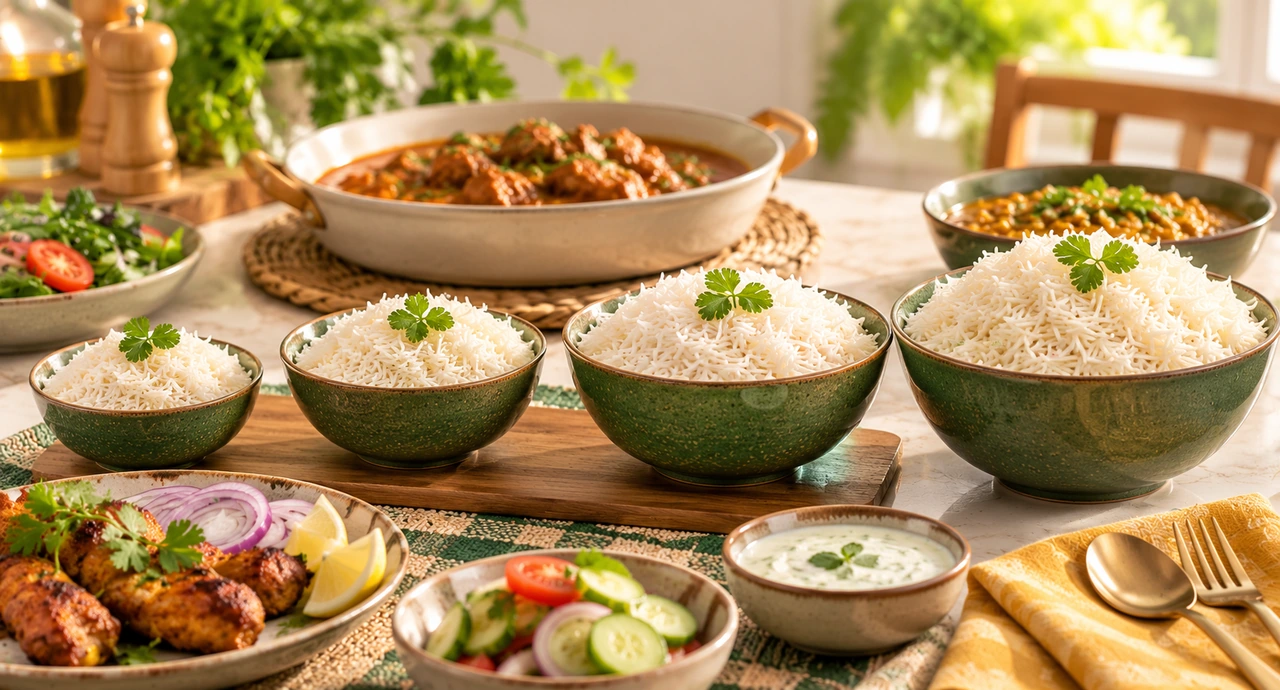
How Much Basmati Rice per Person? Serving Sizes for Everyday Meals
Cooking the right amount of basmati rice can make everyday meals easier. Prepare too little, and your curry or daal may be left without enough rice. Cook too much, and you may end up with leftovers you had not planned to use.
For Pakistani and Indian households living in Japan, estimating rice portions is especially helpful when preparing daal chawal, chicken curry, pulao, or a family dinner.
How much basmati rice per person should you cook? A practical starting point is 75g of uncooked basmati rice per adult for a standard meal. Use around 50g for a smaller side portion or approximately 100g for a generous rice-based meal.
These are flexible cooking estimates, not strict nutritional requirements. The amount you need depends on appetite, the dish, and what else is being served.
This guide includes rice serving charts, cooked-rice estimates, Japanese rice cooker measurements, and simple methods for planning quantities without unnecessary waste.
How Much Basmati Rice Do You Need per Person?
For everyday home cooking, start with these approximate dry rice quantities:
| Type of serving | Uncooked rice per adult | Approximate cooked rice |
|---|---|---|
| Light side serving | 50g | 125–150g |
| Standard meal | 75g | 190–225g |
| Generous rice-based meal | 100g | 250–300g |
All measurements in this guide refer to uncooked, dry rice unless clearly stated otherwise.
Rice absorbs water during cooking, so its weight increases. A typical cooked yield is around 2.5–3 times the dry weight, depending on the variety, water absorption, and cooking method.
For example, 75g of uncooked basmati may produce approximately 190–225g of cooked rice.
That is why measuring uncooked rice is usually the simplest approach when planning how much to prepare.
1. Basmati Rice Serving Chart for 1 to 10 People
If you are preparing rice for a family meal, this chart provides a straightforward starting point.
| People | Light serving (50g each) | Standard serving (75g each) | Generous serving (100g each) |
|---|---|---|---|
| 1 | 50g | 75g | 100g |
| 2 | 100g | 150g | 200g |
| 3 | 150g | 225g | 300g |
| 4 | 200g | 300g | 400g |
| 5 | 250g | 375g | 500g |
| 6 | 300g | 450g | 600g |
| 7 | 350g | 525g | 700g |
| 8 | 400g | 600g | 800g |
| 9 | 450g | 675g | 900g |
| 10 | 500g | 750g | 1,000g |
For four adults eating a standard rice portion, measure approximately 300g of uncooked basmati rice.
If rice is the main part of the meal and everyone enjoys larger servings, you may prefer 400g for four adults.
When the meal includes roti, vegetables, daal, and several other dishes, a smaller rice portion may be enough.
2. How Much Uncooked Rice Makes One Cup of Cooked Rice?
Dry rice and cooked rice are not interchangeable measurements.
As basmati cooks, the grains absorb water and become heavier and larger.
For rough meal planning:
- 50g of dry rice may yield around 125–150g cooked.
- 75g of dry rice may yield around 190–225g cooked.
- 100g of dry rice may yield around 250–300g cooked.
- 200g of dry rice may yield around 500–600g cooked.
The exact amount varies.
A cup is a volume measurement, not a fixed weight. Loosely spooned cooked rice and tightly packed cooked rice will weigh differently.
If you want reliable meal quantities, a digital kitchen scale is more consistent than estimating how much cooked rice fits into a cup.
Why This Difference Matters
Suppose you want to prepare enough cooked rice for two adults.
Using the standard 75g dry portion:
75g × 2 people = 150g uncooked rice
After cooking, that may produce roughly 375–450g of rice.
You do not need to measure 375–450g before cooking. The smaller dry weight is what goes into the pot.
3. How Many Cups of Basmati Rice per Person?
Many people use a measuring cup instead of a kitchen scale.
However, there is an important difference between a standard kitchen cup and the small cup supplied with a Japanese rice cooker.
Standard Measuring Cup vs Japanese Rice Cooker Cup
| Cup type | Approximate volume | Typical dry white rice weight |
|---|---|---|
| Standard US measuring cup | 240ml | Around 180–190g |
| Japanese rice cooker cup | 180ml | Around 140–150g |
These weights are approximate and vary with the rice variety and how the cup is filled.
A standard Japanese rice cooker cup is smaller than a standard US kitchen measuring cup.
How Much Rice Is One Standard Portion?
For a 75g dry portion:
- About 0.4 of a standard US measuring cup
- About half of a Japanese rice cooker cup
These are approximate conversions.
For more precise quantities, use a kitchen scale—particularly when cooking small batches.
A Simple Japanese Rice Cooker Example
Suppose you need rice for two adults.
At 75g each, the target is 150g dry rice.
That is approximately one level Japanese rice cooker cup, depending on the rice and measuring cup.
For four adults, you would need around 300g dry rice, or approximately two Japanese rice cooker cups.
Remember that some rice cookers have minimum and maximum batch sizes. Always check your appliance’s instructions.
4. How Much Basmati Rice for Daal Chawal?
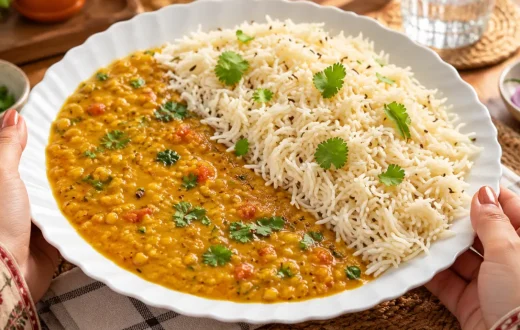
Daal chawal is a familiar and satisfying meal in many Pakistani households.
The right rice quantity depends on how much daal is served and whether the meal includes other dishes.
Rice for Two People
Start with around 150g of uncooked basmati rice for two standard servings.
This may be enough when the rice is served with a generous portion of daal and an accompaniment such as salad or achar.
Rice for Four People
Measure around 300g of uncooked basmati rice as a starting point.
If your household usually eats larger rice portions, increase the amount based on previous meals.
When to Cook Less
You may prefer smaller portions if the meal also includes:
- Roti or chapati
- Several vegetable dishes
- Additional side dishes
- Other substantial foods
The best quantity is one that fits the complete meal, rather than treating rice as the only ingredient.
5. How Much Rice Should You Cook with Chicken Curry?
Chicken curry and basmati rice are another common combination.
A curry containing meat, vegetables, and sauce may be filling, so the rice portion can be adjusted accordingly.
For most everyday meals, 60–75g of uncooked rice per adult is a reasonable initial range.
For example:
| People | At 60g per person | At 75g per person |
|---|---|---|
| 2 | 120g | 150g |
| 3 | 180g | 225g |
| 4 | 240g | 300g |
| 6 | 360g | 450g |
If everyone is particularly hungry or rice forms most of the meal, increase the quantity.
If you are serving bread as well, a smaller rice portion may be enough.
These amounts are meal-planning examples, not a fixed recipe.
6. Does Biryani Need More Rice per Person?
Biryani is different from plain rice served alongside curry.
It combines rice with meat or vegetables, spices, and other ingredients, so the balance of the dish matters.
For a generous biryani serving, around 100g of uncooked basmati per adult can be a useful starting estimate.
For example:
- 2 people: 200g dry rice
- 4 people: 400g dry rice
- 6 people: 600g dry rice
- 8 people: 800g dry rice
These estimates assume biryani is a substantial part of the meal.
If the biryani contains a generous amount of meat and is served with several side dishes, you may need less rice.
If you’re preparing biryani for guests with large appetites, you may need more.
The type of rice and the recipe also influence the final result.
For guidance on selecting rice varieties for traditional biryani, read Why Basmati Rice Is Ideal for Traditional Biryani.
7. How Much Rice Do Children Need?
Children’s serving sizes vary considerably with age, appetite, and the other foods in the meal.
There is no single dry rice quantity suitable for every child.
For family meal planning, start with a smaller amount than you would typically prepare for an adult and adjust based on your child’s usual portions.
For example, a household with two adults and one child might plan:
| Household member | Example dry rice quantity |
|---|---|
| Adult 1 | 75g |
| Adult 2 | 75g |
| Child | 30–50g |
| Total | 180–200g |
These are illustrative quantities, not pediatric dietary recommendations.
For young children, consider age-appropriate serving sizes, safe food textures, and their broader nutritional needs.
If you regularly cook too much or too little, your household’s actual eating habits are a better guide than using a rigid number every day.
8. How to Calculate Rice for Any Number of People
You can calculate the amount of dry rice with a simple formula:
Number of people × Dry rice per person = Total uncooked rice
Example 1: Three Adults
For a standard serving:
3 × 75g = 225g of uncooked rice
Example 2: Six Adults
For a generous serving:
6 × 100g = 600g of uncooked rice
Example 3: Four Adults Eating a Light Side
4 × 50g = 200g of uncooked rice
For a mixed group, calculate adults and children separately using quantities appropriate to the household.
This method works for everyday meals and can also help with small gatherings.
9. Does Rice Variety Change the Serving Size?
The type of rice affects how it cooks, but serving quantities are primarily based on how much rice people intend to eat.
Different varieties may have different cooked textures and yields.
Standard White Basmati
A common choice for daal chawal, curry, and everyday rice dishes.
The 50g, 75g, and 100g portion estimates in this guide are suitable starting points for ordinary white basmati.
Aged Basmati
Aged basmati may have different cooking characteristics and grain elongation.
You can still plan using dry weight, but the cooked volume and water requirements may differ.
Sella or Parboiled Basmati
Sella rice is parboiled before milling and often has a firmer cooked texture.
Its cooking instructions can differ from ordinary white basmati.
When calculating portions, start with the dry weight, then adjust based on how much your household usually eats.
To understand the differences between rice varieties, read Different Types of Basmati Rice Available in Japan.
10. How Much Rice Should a Small Household Buy?
Serving calculations are useful not only for cooking but also for grocery shopping.
If you know how many rice meals your household usually prepares, you can estimate how long a bag might last.
How Long Will a 1kg Bag Last?
At a standard portion of 75g dry rice per person:
1,000g ÷ 75g = approximately 13 individual servings
That means a 1kg bag might provide:
- About 13 standard servings for one person
- About 6 complete two-person meals
- About 3 complete four-person meals
Actual usage depends on portion sizes and recipes.
How Long Will a 5kg Bag Last?
A 5kg bag contains 5,000g of dry rice.
At 75g per serving:
5,000g ÷ 75g = approximately 66 individual servings
For a couple, that is roughly 33 two-person rice meals.
If the couple cooks rice three times a week, the bag would last approximately 11 weeks at that consistent serving size.
In practice, some meals may require larger portions, so treat this as a planning estimate.
Small Bag or Large Bag?
A larger bag may be suitable if your household cooks rice frequently and has an appropriate storage area.
A smaller pack may be more practical if:
- You live alone.
- You cook rice only occasionally.
- You are trying a new rice variety.
- Your kitchen storage space is limited.
Do not purchase a large bag solely because it looks more economical. Consider how quickly you will use it and whether you can store it properly.
11. How to Avoid Cooking Too Much Rice
Reducing unnecessary leftovers starts with knowing how much your household eats.
Measure Before Cooking
Use a scale or consistent measuring cup.
Avoid pouring rice directly into the pot without measuring when you’re unsure how much you need.
Keep a Record of Successful Portions
If 300g of dry rice is consistently enough for your family of four, use that amount as your normal starting point.
If you frequently have leftovers, reduce the quantity slightly next time.
Consider the Whole Meal
A dinner with curry, roti, salad, and vegetables may require less rice than a meal built mainly around rice.
Handle Leftover Rice Safely
Cooked rice requires careful handling because bacterial spores may survive cooking and can grow if rice is left at unsafe temperatures.
Cool leftover rice promptly in shallow containers, refrigerate it without unnecessary delay, and follow applicable food-safety guidance for refrigerated storage.
Avoid leaving cooked rice at room temperature for long periods. Reheat refrigerated rice thoroughly, and do not repeatedly cool and reheat the same batch.
For quality and safety, preparing an appropriate amount in the first place is often the easiest option.
12. Buying Basmati Rice in Japan
If you regularly prepare Pakistani or Indian meals, keeping a suitable basmati rice variety at home can make everyday cooking more convenient.
MT Halal Mart offers rice and other South Asian grocery products through its online store with delivery across Japan and its physical grocery location in Yotsukaido, Chiba.
Its rice selection includes products such as:
- Shahi Qilla Ultimate Basmati Rice 5kg
- Fortune Everyday Basmati Rice 5kg
- Guard Supreme Basmati Rice 5kg
- Guard Paradise Basmati Rice 5kg
- Selected Sella rice varieties
Brands, package sizes, prices, and stock availability can change.
Browse the MT Halal Rice Category to check the current selection.
What to Check Before Ordering
Before buying basmati rice, review:
- The rice variety
- Package weight
- Product description
- Cooking instructions
- Current availability
- Storage recommendations
- How often your household cooks rice
For shoppers in Japan, comparing the package weight with your expected number of meals is a practical way to avoid overbuying.
You can also browse the MT Halal Online Shop for other grocery essentials to serve alongside your rice meals.
Frequently Asked Questions
How much uncooked basmati rice do I need for one person?
Approximately 75g of dry basmati rice is a practical starting point for one standard adult serving. Use less for a small side dish or more for a generous rice-based meal.
Is 100g of uncooked basmati rice enough for one person?
For many adults, 100g is a generous dry rice portion. It may produce approximately 250–300g of cooked rice, depending on the cooking method.
How much basmati rice should I cook for two people?
For two standard servings, start with 150g of uncooked rice. If rice is the main part of the meal, 200g may be more suitable.
How much basmati rice is needed for four people?
Around 300g of dry basmati is a reasonable standard starting quantity for four adults. For larger rice-focused portions, consider 400g.
How much rice should I cook for ten people?
For standard servings, approximately 750g of uncooked basmati rice is a useful starting estimate. Adjust the amount based on appetite and the number of accompanying dishes.
How much cooked rice does 75g of dry basmati make?
Depending on water absorption and preparation, 75g of dry basmati may produce approximately 190–225g of cooked rice.
Is one Japanese rice cooker cup enough for two people?
One Japanese rice cooker cup holds approximately 180ml and typically contains around 140–150g of dry white rice. That is close to two standard 75g dry rice portions, depending on the rice variety.
How many servings are in a 5kg bag of basmati rice?
At 75g per person, a 5kg bag contains approximately 66 individual dry rice servings. Larger or smaller portions will change the total.
Final Thoughts: Measure Rice According to the Meal
Knowing how much basmati rice to cook per person makes meal preparation easier, especially when cooking for a small household or a family in Japan.
For a simple starting point, remember:
- 50g dry rice: Light side serving
- 75g dry rice: Standard serving
- 100g dry rice: Generous rice-based serving
Adjust these amounts based on appetite, recipe, and the other foods being served.
If you’re using a Japanese rice cooker, remember that its measuring cup is generally smaller than a standard kitchen cup. Using a scale can help you avoid measurement errors.
Whether you’re cooking daal chawal, serving basmati with curry, or preparing rice for guests, a little portion planning can help you make the right amount.
Explore the MT Halal Rice Category to find suitable basmati rice products for everyday Pakistani and Indian cooking in Japan.