Atta vs All-Purpose Flour: Which to Use for Roti and Paratha?
Making soft roti or flaky paratha at home can be surprisingly challenging when the flour available in your kitchen is different from what you used in Pakistan or India.
For people living in Japan, this is a familiar situation. A local supermarket may offer several types of wheat flour, but not every variety produces the same result as traditional South Asian atta.
You might find all-purpose flour, Japanese bread flour, cake flour, or imported whole wheat atta. Although these products come from wheat, they differ in milling, protein content, texture, and how they behave when mixed with water.
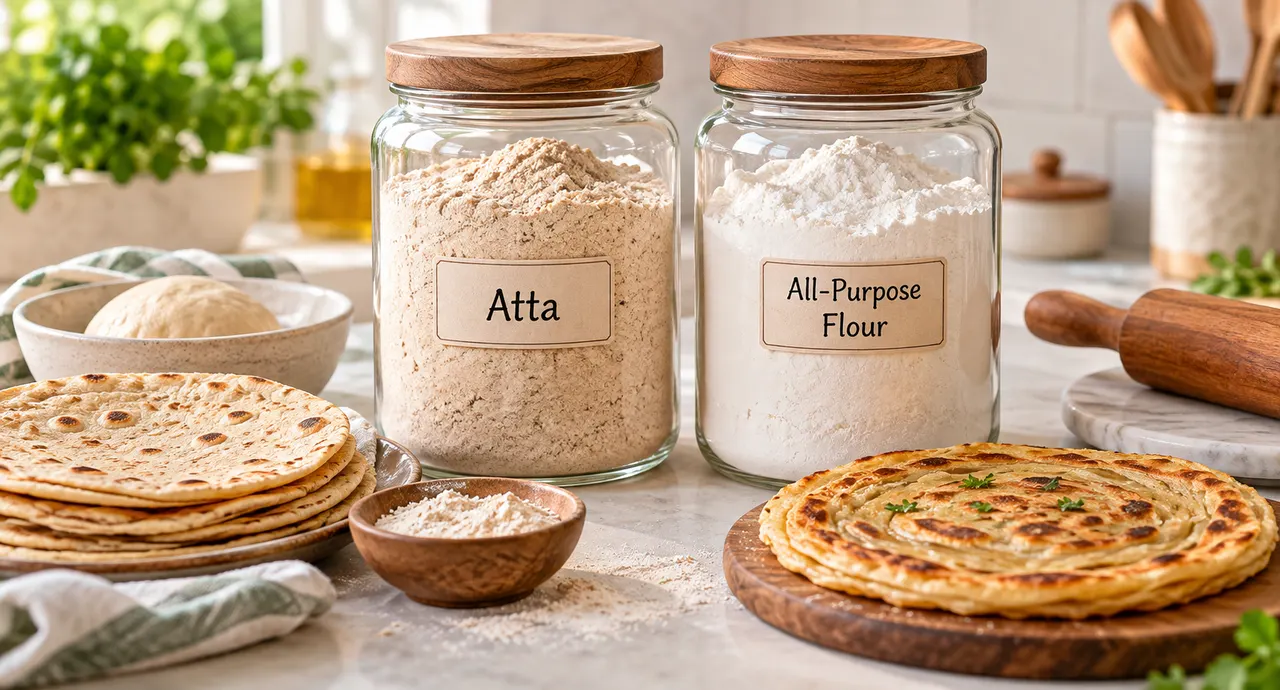
For traditional everyday roti and chapati, whole wheat atta is usually the better choice. For paratha, both atta and all-purpose flour can work, but they create different textures. Atta is well suited to traditional whole wheat paratha, while refined flour can produce a softer, lighter or more layered result depending on the recipe.
This guide compares atta and all-purpose flour, explains how each affects your dough, and helps you choose suitable flour for Pakistani and Indian home cooking in Japan.
What Is the Difference Between Atta and All-Purpose Flour?
Atta is a wheat flour traditionally used for South Asian flatbreads such as roti, chapati and paratha.
Most commercially available whole wheat atta contains the bran, germ and endosperm of the wheat grain. It is commonly milled to produce flour suitable for making pliable flatbread dough.
All-purpose flour is a refined wheat flour that generally contains mainly the endosperm. It has a lighter color and usually produces a smoother dough.
In South Asian cooking, refined white flour is commonly called maida, although the exact protein content and milling characteristics of maida and Japanese all-purpose flour are not always identical.
Atta vs All-Purpose Flour: Quick Comparison
| Feature | Whole Wheat Atta | All-Purpose Flour |
|---|---|---|
| Type | Whole wheat flour | Refined wheat flour |
| Color | Light brown or beige | White or off-white |
| Fiber | Generally higher | Generally lower |
| Dough texture | Depends on milling; typically pliable for roti | Often smooth and elastic |
| Flavor | More pronounced wheat flavor | Mild flavor |
| Common uses | Roti, chapati, whole wheat paratha | Refined-flour flatbreads, baking, some parathas |
| Best everyday use | Traditional roti and chapati | Recipes designed for refined flour |
The biggest difference for home cooks is how the flour absorbs water and develops texture during kneading and cooking.
1. Why Whole Wheat Atta Is Usually Best for Roti
Traditional Pakistani roti and chapati are commonly prepared using whole wheat atta, water, and sometimes a small amount of salt.
The dough is kneaded, rested, divided into small balls and rolled into thin circles before being cooked on a hot tawa.
Good atta allows you to prepare a dough that can be rolled without excessive cracking and cooked into a flexible flatbread.
How Atta Affects Roti Texture
The final result depends on the flour’s milling characteristics, hydration, dough resting time, and cooking technique.
Atta that is designed for chapati preparation generally offers a familiar combination of softness and elasticity.
Whole wheat flour also has a slightly deeper wheat flavor than refined flour.
Can Whole Wheat Roti Stay Soft?
Yes. The flour matters, but technique is equally important.
For softer roti:
- Add water gradually until the dough feels soft and manageable.
- Knead until the ingredients form a smooth, cohesive dough.
- Allow the dough to rest before rolling.
- Avoid adding excessive dry flour while rolling.
- Cook on a properly heated tawa.
- Avoid overcooking or repeatedly drying the roti.
- Keep cooked rotis covered briefly so they do not lose moisture too quickly.
An overly stiff dough often produces a harder roti, even when you use good-quality atta.
2. Can You Make Roti with All-Purpose Flour?
Yes, you can make a flatbread using all-purpose flour and water.
However, it will not necessarily have the same flavor, structure, or texture as traditional whole wheat roti.
All-purpose flour is refined, so the dough generally feels smoother and has a milder wheat flavor.
Depending on the flour’s protein content and your cooking method, the finished bread may be softer, chewier, or less like the chapati you are familiar with.
When All-Purpose Flour Might Be Useful
All-purpose flour can be a practical substitute if:
- You cannot find atta immediately.
- You want to experiment with a different flatbread texture.
- Your recipe specifically calls for refined flour.
- You are making a layered flatbread rather than traditional whole wheat roti.
If you want a result closer to Pakistani chapati, using atta intended for flatbreads is generally the more predictable option.
Can You Mix Atta and All-Purpose Flour?
Yes. Mixing the two is one way to adjust the dough’s texture.
For example, you could test:
75% whole wheat atta + 25% all-purpose flour
For 400g total flour:
- 300g atta
- 100g all-purpose flour
This is an experimental blend, not a required traditional recipe.
You may find that it changes the way the dough rolls and cooks. Because flour absorption differs, add water gradually rather than using a fixed quantity without adjustment.
3. Which Flour Is Better for Paratha?
Both atta and all-purpose flour can be used for paratha.
The right choice depends on the style of paratha you want.
Whole Wheat Atta for Traditional Paratha
Atta works well for everyday Pakistani-style paratha cooked on a tawa.
A basic whole wheat paratha uses:
- Atta
- Water
- Optional salt
- Oil or ghee for layering and cooking
This produces a flatbread with a recognizable wheat flavor.
Depending on how the dough is rolled and folded, it can be soft, slightly crisp, or layered.
All-Purpose Flour for Layered Paratha
Refined flour is often used for certain layered or flaky flatbread preparations.
It can create smooth dough that stretches and folds effectively when handled correctly.
However, flakiness is not caused by flour type alone.
The rolling, folding, fat distribution, resting time, and cooking method are major factors in creating layers.
A paratha made entirely with atta can also be flaky when properly layered.
Atta vs Maida for Paratha
| Paratha style | Suitable flour | Expected result |
|---|---|---|
| Everyday Pakistani paratha | Whole wheat atta | Traditional wheat flavor and texture |
| Aloo paratha | Whole wheat atta | Flexible dough suitable for stuffing |
| Layered whole wheat paratha | Atta with oil or ghee | Distinct layers when folded correctly |
| Refined-flour layered paratha | Maida or suitable all-purpose flour | Smoother dough and potentially lighter layers |
| Mixed-flour paratha | Atta and all-purpose flour | Intermediate texture depending on ratio |
For everyday roti and paratha, keeping whole wheat atta at home is a practical starting point.
4. How to Make Soft Roti with Atta
If you are learning to make chapati in Japan, start with a small batch.
Ingredients for Approximately Four Rotis
- 200g whole wheat atta
- Approximately 130–150ml water, adjusted as needed
- Optional pinch of salt
- Additional dry atta for rolling
The amount of water varies by flour brand and milling characteristics.
Step 1: Prepare the Dough
Place the atta in a mixing bowl.
Add water gradually while mixing.
Once the flour begins to come together, knead it into a soft dough.
Step 2: Knead and Rest
Continue kneading until the dough becomes relatively smooth and cohesive.
Cover and rest it for approximately 15–30 minutes.
Resting allows the flour to hydrate and generally makes rolling easier.
Step 3: Divide and Roll
Divide the dough into four equal portions.
Shape them into balls and roll each one into a thin circle on a lightly floured surface.
Try to maintain an even thickness.
Step 4: Cook on a Tawa
Heat a tawa or suitable flat pan over medium-high heat.
Place one rolled roti on the hot surface.
Cook until small bubbles appear, turn it over, and cook the second side.
Continue according to your preferred method until the roti is fully cooked.
Avoid leaving the roti on the pan unnecessarily, as excess cooking can dry it out.
Step 5: Serve
Keep the finished rotis covered in a clean container or suitable cloth while you prepare the remaining batch.
Serve with daal, vegetable curry, chicken karahi or another preferred dish.
5. How to Make a Simple Whole Wheat Paratha
A basic paratha uses dough similar to roti but includes oil or ghee during preparation.
Ingredients for Approximately Four Parathas
- 250g whole wheat atta
- Approximately 160–190ml water, as needed
- A pinch of salt
- Oil or ghee for layering and cooking
Preparation Method
- Combine the flour, salt and water to make a soft dough.
- Knead and rest for approximately 20 minutes.
- Divide into four portions.
- Roll one portion into a small circle.
- Spread a thin layer of oil or ghee over the surface.
- Fold or pleat the dough according to your preferred layering technique.
- Rest briefly if the dough resists rolling.
- Roll again without pressing out all the layers.
- Cook on a medium-hot tawa with a little oil or ghee until both sides are cooked and golden.
The finished texture will depend on how thinly you roll the dough and how much fat you use.
For a stuffed paratha such as aloo paratha, use a pliable dough that can hold the filling without tearing.
6. Why Does Roti Become Hard or Dry?
Hard roti is not always caused by choosing the wrong flour.
Common problems include insufficient dough hydration, excessive dry flour, overcooking, and improper resting.
Roti Troubleshooting Guide
| Problem | Possible cause | How to improve it |
|---|---|---|
| Roti becomes hard | Dough too stiff or overcooked | Use softer dough and avoid excessive cooking |
| Dough cracks while rolling | Not enough water or resting | Add water gradually and rest the dough |
| Roti sticks to the rolling board | Excess water or inadequate dusting | Use a little dry flour |
| Roti does not puff | Uneven thickness or insufficient heat | Roll evenly and adjust tawa temperature |
| Paratha turns tough | Heavy kneading after layering or excessive cooking | Handle layered dough gently |
| Dough is overly sticky | Too much water for the flour | Rest first, then adjust with small amounts of flour |
If your roti repeatedly turns out dry, change one variable at a time.
For example, try slightly increasing water while keeping the same flour brand, resting time, and cooking method.
This makes it easier to find what works.
7. Is Whole Wheat Atta Healthier Than All-Purpose Flour?
Whole wheat atta generally contains more dietary fiber than refined all-purpose flour because more of the wheat grain is retained during milling.
It also typically provides more naturally occurring nutrients associated with the bran and germ.
Refined flour generally has less fiber, although enrichment or fortification can change its nutrient profile.
Nutritional Comparison
| Nutritional consideration | Whole Wheat Atta | All-Purpose Flour |
|---|---|---|
| Dietary fiber | Generally higher | Generally lower |
| Wheat bran | Typically retained | Mostly removed |
| Wheat germ | Typically retained | Mostly removed |
| Protein | Varies by wheat and product | Varies by wheat and product |
| Calories | Both provide substantial energy | Both provide substantial energy |
There is no need to label all-purpose flour as inherently unhealthy.
The overall nutritional value of a meal also depends on portion size, added fats, fillings, vegetables and other foods.
For everyday whole grain intake, whole wheat atta can be a useful choice.
8. Understanding Japanese Wheat Flour Labels
When shopping in Japan, you may come across several types of wheat flour.
Knowing the basic Japanese names can help you avoid buying the wrong product.
| Japanese term | Meaning | Common use |
|---|---|---|
| 小麦粉 (Komugiko) | Wheat flour | General label for wheat flour |
| 薄力粉 (Hakurikiko) | Weak or low-protein flour | Cakes and some baked goods |
| 中力粉 (Chūrikiko) | Medium-strength flour | Udon and general cooking |
| 強力粉 (Kyōrikiko) | Strong or high-protein flour | Bread and yeast dough |
| 全粒粉 (Zenryūfun) | Whole wheat flour | Whole grain baking and cooking |
Is Japanese Whole Wheat Flour the Same as Atta?
Not necessarily.
Japanese whole wheat flour and South Asian atta may both contain the whole wheat grain, but their milling characteristics, particle size, wheat type and protein properties can differ.
This can affect dough hydration, elasticity and the texture of the finished roti.
If you want a familiar Pakistani chapati texture, atta marketed for roti or chapati is generally the more reliable option.
Can Japanese All-Purpose Flour Replace Maida?
Sometimes, but the results may vary.
Japan’s medium-strength flour can be useful in recipes requiring moderate gluten development, while strong flour has more gluten-forming potential.
Neither is automatically identical to South Asian maida.
If you are experimenting with substitutions, begin with a small batch and adjust the water and handling method based on how the dough behaves.
9. How to Choose Flour for Different Pakistani Dishes
Different recipes benefit from different flour characteristics.
| Dish | Common flour choice | Why |
|---|---|---|
| Roti or Chapati | Whole wheat atta | Traditional flavor and texture |
| Plain Pakistani Paratha | Whole wheat atta | Works well for everyday tawa cooking |
| Aloo Paratha | Whole wheat atta | Suitable for stuffed dough |
| Layered Refined-Flour Paratha | Maida or suitable refined flour | Supports smooth, layered dough |
| Puri | Atta, maida or a blend | Depends on the desired style |
| Naan | Often refined flour or a combination | Depends on the specific recipe |
| Everyday Whole Wheat Flatbread | Atta | Familiar whole grain result |
These are common cooking choices, not absolute rules.
Pakistani and Indian recipes vary widely between households and regions.
10. Buying Atta and Flour in Japan
For people preparing Pakistani and Indian meals at home, finding suitable atta can make everyday cooking easier.
MT Halal Mart offers flour and other South Asian grocery products through its online store with delivery across Japan, alongside its physical grocery store in Yotsukaido, Chiba.
The store’s Flour & Atta category has featured products such as:
- Aashirvaad Whole Wheat Atta
- Gyan Chakki Whole Wheat Atta
- Morita Atta
- Hajji Baba Atta
- White Flour (Maida)
Different brands and package sizes may be available, but stock levels change.
Browse the MT Halal Flour & Atta Category to review the current selection.
What to Check Before Buying Atta
Look at:
- Whether the flour is whole wheat or refined
- Intended use, such as roti or baking
- Package weight
- Ingredient information
- Storage recommendations
- Current stock availability
- Any specific product instructions
Do not assume that all products labeled wheat flour will perform the same way.
For general information on South Asian pantry ingredients, read Everyday Halal Groceries Available in Japan Through MT Halal.
11. Storing Atta and All-Purpose Flour Properly in Japan
Japan’s warm and humid seasons can make dry-food storage especially important.
Once opened, transfer flour to a clean, dry, food-safe container with a secure lid, unless the original packaging provides suitable protection.
Keep it away from direct sunlight, heat and moisture.
Whole Wheat Atta
Whole wheat atta retains more of the wheat grain’s natural oils, which can make it more susceptible to quality deterioration than refined flour.
Follow the product’s storage instructions, avoid buying more than you can use within a reasonable period, and check for signs of spoilage before use.
All-Purpose Flour
Refined flour may maintain its quality longer under suitable conditions, but it still needs protection from moisture, insects and contamination.
If the flour develops an unusual smell, visible mold, or evidence of pests, do not use it.
Proper storage is especially useful when buying larger atta bags for a small household.
Frequently Asked Questions
Is atta or all-purpose flour better for roti?
Whole wheat atta is generally the better choice for traditional Pakistani and Indian roti because it is formulated for whole wheat flatbread preparation and provides a familiar flavor and texture.
Can I make soft chapati with all-purpose flour?
Yes, but the result may differ from traditional whole wheat chapati. Dough hydration, kneading, resting and cooking technique all influence softness.
Which flour is best for paratha?
Whole wheat atta works well for everyday Pakistani paratha and stuffed paratha. Refined flour may be preferred for certain layered or flaky varieties.
Is maida the same as all-purpose flour?
Both are refined wheat flours, but their exact milling and protein characteristics may differ. They are often used similarly, though results depend on the specific product and recipe.
Can I mix whole wheat atta with all-purpose flour?
Yes. You can experiment with blends to adjust dough texture. For example, a mixture of 75% atta and 25% all-purpose flour is one possible starting point.
Is Japanese whole wheat flour suitable for Pakistani roti?
It may be suitable, but it is not necessarily identical to traditional South Asian atta. The texture and water absorption can differ.
Why does my roti turn hard after cooking?
Possible causes include stiff dough, inadequate resting, excessive dry flour or overcooking. Using appropriately hydrated dough and avoiding excessive cooking can help.
Where can I buy atta in Japan?
MT Halal Mart offers atta and other flour products through its online grocery shop with delivery across Japan and its physical store in Yotsukaido, Chiba. Check the current product catalog for availability.
Final Thoughts: Choose Flour Based on the Flatbread You Want
Atta and all-purpose flour each have a place in home cooking, but they are not identical ingredients.
Choose whole wheat atta for traditional roti, chapati and everyday whole wheat paratha.
Choose all-purpose flour or maida for recipes that specifically call for refined flour, including certain layered flatbreads and other baked preparations.
If you’re living in Japan and want familiar Pakistani home-cooked roti, starting with good-quality atta and a consistent dough method is usually the most practical approach.
Pay attention to the flour’s water absorption, give the dough enough resting time, and adjust your cooking technique before assuming the flour is the problem.
To explore available wheat flour products, visit the MT Halal Flour & Atta Category and choose the option that suits your next homemade roti or paratha.